Crowd Express: Boarding Puzzle
- 4.5
- Rating
- 5.00M
- Installs
- Free
- Price
 Analysis by App-foxy
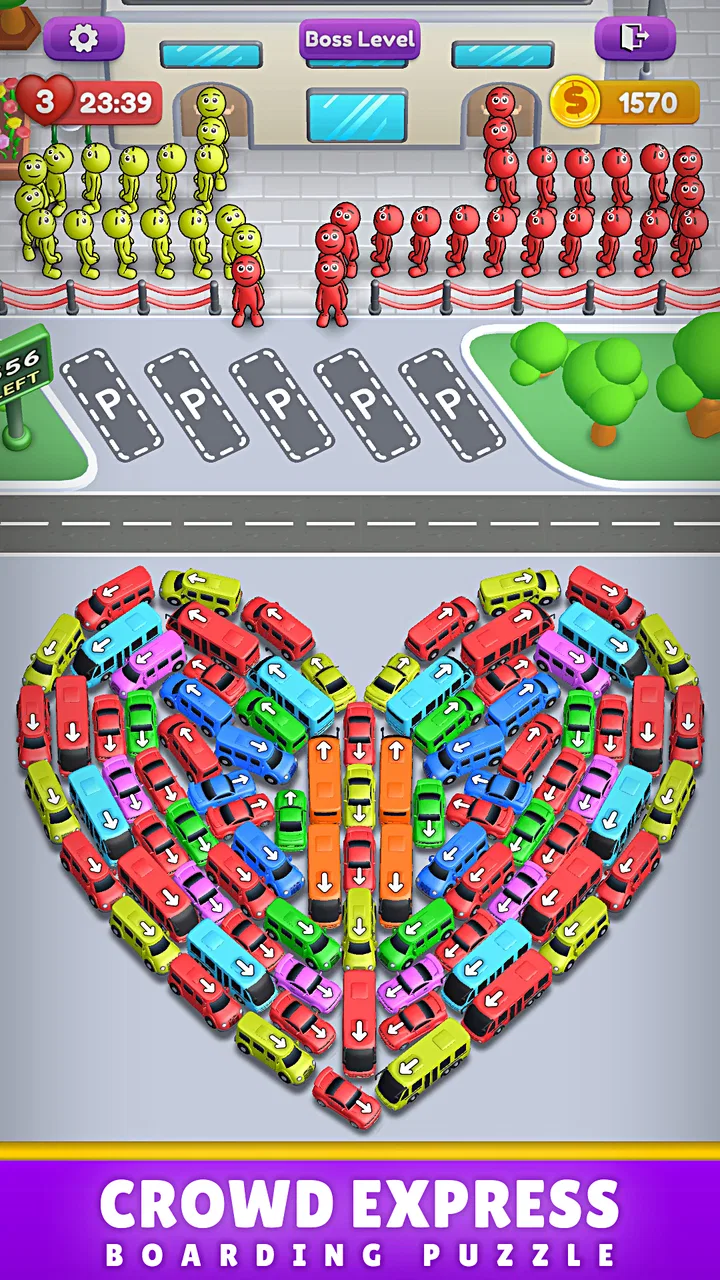
I approached Crowd Express: Boarding Puzzle as a quick puzzle game rather than a full-scale traffic simulator. Its central idea is easy to understand: cars, buses, crowded roads, and boarding problems are turned into bite-sized challenges where the goal is to make sensible moves before the situation becomes tangled. That makes it immediately approachable, but the real question is whether the simple premise stays interesting after the first few sessions.
In my experience, it works best when I want something light that I can play without learning a complicated control system. I can open it, understand the immediate objective, and start solving. At the same time, it is not the right match for everyone. Players looking for deep strategy, a long narrative, or the kind of puzzle design that demands careful planning over extended sessions may find this format too casual.
Developed by Rollic Games, this free puzzle title has an Everyone age rating and has reached over a million installs. Its average rating is 3.6 from around 4.9 thousand ratings, which gives a useful hint about its appeal: plenty of people are willing to try the concept, but the experience will not satisfy every type of mobile player.
You May Also Like

 Blood Strike: 2.5 Anniversary
Blood Strike’s Loadouts Turn Every Drop Into a Tactical Gamble
A close look at Blood Strike’s custom loadouts: how fast access to signature weapons reshapes its battle royale rhythm, rewards preparation, and narrows the gap between fights.

 Pandora - Music & Podcasts
Pandora’s Music Is Easy to Start, but Harder to Recover
Pandora’s strength is its low-effort path from a seed to a station. Its weak spot is how much confidence it asks you to place in connection, setup, and quiet recovery.

 8 Ball Pool
 Is Built on Rivalries, Rematches, and Routine
A close look at the rivalries, rematches, shared routines, and unanswered safety questions that turn a quick pool match into a persistent mobile community.

 Samsung Music
’s Quiet Strength Is Playing What You Already Own
Its reach comes less from spectacle than from dependable access to a personal library. That simplicity is both the app’s strongest retention engine and its ceiling.

 AccuWeather: Weather Radar
AccuWeather Review: A Quick, Clear Forecast for Everyday Decisions
For everyday plans, the best forecast is the one you can understand quickly. AccuWeather makes rain timing, radar, and local conditions easy to act on, with a few trade-offs.

 Hill Climb Racing
Why Hill Climb Racing Still Turns Crashes Into One More Run
A tiny car, a bumpy hill and one more upgrade: Hill Climb Racing keeps resurfacing because its simple chaos makes every near-miss feel personal.
More From Our News Desk



The first week: quick appeal, with a simple learning curve
In the first few sessions, the appeal is easy to understand: the traffic scene gives me something concrete to inspect, and I can begin making decisions without studying a long rulebook. That makes it a practical choice when I have only a short pause between errands or want a low-pressure game before bed. It also means the first impression depends heavily on whether I enjoy visual sorting and sequencing; the theme helps explain the puzzle, but it cannot make that kind of thinking enjoyable for someone who dislikes it.
A useful way to test the fit is to play with a small goal rather than expecting a full evening of entertainment. I would try a few boards, notice whether I naturally start looking for bottlenecks, and see whether I want to attempt another after solving one. If I find myself moving pieces just to finish quickly, the central loop may not be for me. If I enjoy pausing to compare possible routes, the modest premise has room to become a satisfying little habit.
How I Decide Whether the Traffic Puzzles Are Worth Playing
I judge a quick puzzle game by whether it still feels useful once the first-week curiosity has passed, not by how many levels I can rush through at the start. Here, I’d pay attention to whether I keep spotting fresh ways to untangle a crowded board, and whether a short session leaves me satisfied rather than merely ready to tap again. That’s the test I use to decide if it earns a small, regular place in my routine.
The first test is clarity, not difficulty
For this kind of game, I care less about how impressive the theme sounds and more about how quickly the board communicates its problem. A good level should let me see which vehicles are blocking one another, which passengers or buses need attention, and what kind of order might solve the jam. Crowd Express: Boarding Puzzle benefits from having a familiar everyday setting. I do not need a tutorial about why a blocked lane is a problem; the visual situation makes sense almost immediately.
That accessibility is one of its strongest qualities. I can play while taking a short break, and I do not need to remember a large collection of rules between sessions. The game is especially suitable for players who enjoy sorting, arranging, and untangling situations but do not necessarily want a traditional match-three board or a word puzzle.
Look for planning, not just tapping
The useful mindset is to treat each level as a small traffic-management problem. My first instinct in a crowded layout is often to move the most obvious vehicle, but that is not always the best opening. A vehicle that appears ready to leave may be occupying space needed by another route. I get better results when I pause briefly, identify the bottleneck, and ask which move creates the most room rather than which move looks fastest.
This is a small distinction, but it changes the feel of the game. If I tap randomly, the board can become harder to read. If I use the opening moments to inspect the whole arrangement, I make fewer unnecessary moves and understand the puzzle more clearly. That habit is one of the more valuable things the game teaches, even though it is never as obvious as the basic traffic theme.
Short sessions are a real advantage
The game fits naturally into everyday gaps. I can imagine playing it while waiting for an appointment, during a commute when I am seated, or after finishing a task and wanting a few minutes of low-pressure entertainment. It does not demand the emotional commitment of a role-playing game, and it is easier to put down than a competitive multiplayer title.
That convenience also shapes my expectations. I do not judge it by the standards I would use for a large adventure game. I judge it by whether the next puzzle gives me a clear problem, whether the solution feels earned, and whether the session ends before the repetition becomes tiring. On those terms, it has a sensible purpose.
What the rating and version tell me as a buyer
The current version is 3.1.2, and the game requires Android 9 or later. That matters if I am installing it on an older device, because compatibility is not simply a question of whether the phone can run other casual games. I would check the operating-system requirement before planning to play on an older handset or tablet.
The free entry price makes trying it easy, but free does not automatically mean frictionless. In-app purchases range from $1.99 to $99.99 per item. I would therefore approach it as a game that can be sampled without paying, while keeping purchase controls in mind if children use the device or if I am prone to spending when I get stuck.
Where the game wins over familiar puzzle formats
Its biggest advantage is the combination of a recognizable setting and straightforward spatial reasoning. Match-three games are often about pattern recognition and timed chains. Word games depend on vocabulary. Classic sliding-block puzzles usually reduce the board to a very abstract arrangement. Crowd Express: Boarding Puzzle gives me a more concrete problem: traffic has to be navigated and boarding has to be managed.
That context makes each move feel more purposeful. I am not simply clearing colored pieces; I am trying to restore order to a crowded transport scene. For players who like the idea of a jam-solving puzzle but want something more visual than numbers or letters, this is a convincing reason to try it.
Another strength is the low barrier to entry. I can recommend it to a casual player who might be put off by games with elaborate upgrade trees or dense menus. The Everyone rating also makes its general presentation suitable for a broad audience, although I would still supervise purchases on a shared family device.
Three habits that make the puzzles easier
First, I scan for the vehicle or route that is limiting the rest of the board. The most visible object is not always the most important one. Clearing a central obstruction can be more useful than immediately sending away something at the edge.
Second, I avoid spending a move simply because it is available. In a traffic puzzle, an apparently harmless action can remove a useful buffer and leave the remaining vehicles with fewer options. I prefer moves that either open a lane, separate a cluster, or reveal a clearer sequence.
Third, when I reach a level that feels confusing, I mentally reverse the goal. Instead of asking how to begin, I imagine what the board should look like just before completion and work backward toward the first necessary clearance. This is particularly helpful when several vehicles appear to compete for the same space.
These are not complicated techniques, but they prevent the game from becoming a test of random tapping. They also explain why the title can feel more thoughtful than its cheerful presentation initially suggests.
Where the experience may become less comfortable
The same simplicity that makes the game welcoming can limit its appeal. If I want a puzzle game with a strong story, unusual rules, or a sense of discovery that changes dramatically from chapter to chapter, this is probably not my first choice. The traffic-and-boarding theme provides structure, but it does not replace the variety found in more experimental puzzle games.
I also need to be comfortable with the possibility that progress may feel less satisfying once the basic solving pattern becomes familiar. Casual puzzle games often depend on a steady stream of small challenges rather than one deep system. That is ideal for occasional play, but less compelling for someone who wants to study a single mechanic at a very high level.
The purchase range is another reason I would be cautious. I can start for free, which lowers the risk of trying it, but the presence of optional items means I would not hand the phone to a child without purchase protections. Players who strongly prefer a single upfront payment may also feel more comfortable with a premium puzzle alternative instead.
Who should choose a different category
I would steer away from this game if my priority were competitive ranking, cooperative play, or a long-term collection system. Nothing about the core appeal suggests that it is meant to replace those categories. Someone who wants to compete against friends in real time would likely be happier with a multiplayer game, while someone who wants carefully authored logic problems might prefer a dedicated brain-training or minimalist puzzle title.
It is also not my recommendation for anyone who dislikes repeating a familiar interaction with changing layouts. The setting may make the puzzles more inviting, but the underlying pleasure still comes from arranging movement and resolving congestion. If that loop does not sound enjoyable, a different puzzle format will be a better use of storage space and attention.
What switching away would cost
Moving to another puzzle category is easy in one sense: I do not have to learn a complicated backstory or rebuild a large collection before trying something else. The cost is mainly losing the particular combination of transport imagery and quick problem solving. A word game may offer more variety in language, a match-three game may provide more immediate visual feedback, and a traditional logic game may offer deeper deduction, but none of those alternatives creates exactly the same feeling of untangling a crowded boarding scene.
There is also a practical cost to switching if I already enjoy the game’s pace. Many alternatives ask for longer concentration, more reading, or more active competition. Crowd Express: Boarding Puzzle is convenient precisely because it keeps the commitment small. I would only leave it when the lack of depth, the purchase model, or the repeated traffic format becomes more important than that convenience.
Month to month: does it earn a place in my routine?
For lasting value, I would judge it less by how many times I open it in a burst and more by whether the traffic puzzles still feel welcome after the novelty of the setting wears off. Its strongest case is as a dependable spare-minute option, not as the one game I expect to occupy every evening. That distinction matters: a title can be useful without offering endless variety, provided I enjoy returning to its particular kind of problem.
A realistic routine might be a level or two while waiting for a delayed appointment, then closing the game as soon as I am called. In that situation, the short-form puzzle structure is an advantage: I can leave without needing to remember a story or coordinate with other players. If I instead want a long session with a clear sense of progression, I would choose a more substantial puzzle adventure. The right comparison is not whether this replaces every game on my phone, but whether it fills a small, recurring gap well.
Keeping the game low-friction
I would make the experience easier to live with by deciding in advance how I want to handle purchases. Since individual in-app items can range from $1.99 to $99.99, I would check the device’s purchase safeguards before letting a child play and set my own boundary before a frustrating puzzle tempts me to spend. That is a practical trade-off of a free-to-start game: trying the core experience costs nothing, but impulse control matters more when optional purchases are present.
I would also treat a difficult board as a reason to pause rather than as a reason to keep tapping. Looking over the layout again, identifying the bottleneck, and working backward from the desired final arrangement makes the play session calmer and more deliberate. This does not add a new game mechanic; it is simply a way to get more satisfaction from the spatial puzzle without turning a short break into a source of irritation.
My recommendation for different kinds of players
I recommend giving it a try if I want a free, approachable mobile puzzle built around traffic jams and boarding decisions. It is a good fit for short breaks, family-friendly casual play, and players who enjoy looking at a crowded layout and finding an efficient order of actions. The best way to play is patiently: inspect the whole scene, identify the bottleneck, and use moves to create space rather than simply reacting to the nearest vehicle.
I would be more selective if I were choosing a game for a serious puzzle enthusiast. The title has enough planning to be engaging, but its appeal is tied to its accessible format rather than an especially demanding or story-rich design. I would also keep the purchase range in mind and use device-level safeguards where appropriate.
Overall, I see this as a pleasant casual option rather than a definitive puzzle experience. It succeeds when I need a quick, visual challenge that I can understand immediately, and it loses ground when I want deep systems or a stronger sense of progression. If that balance matches the way you play on mobile, Crowd Express: Boarding Puzzle is worth installing as a no-cost first try. If you are searching for intricate logic, competition, or a premium one-time purchase, I would choose a different category instead.
FAQs for Crowd Express: Boarding Puzzle
01What is the main objective of Crowd Express: Boarding Puzzle?
Crowd Express: Boarding Puzzle is a strategy-based game where the main objective is to efficiently manage and organize passengers boarding a train. Players must use problem-solving skills to ensure that all passengers are seated correctly, considering factors like group sizes and seating preferences, to achieve the highest score.
02Is Crowd Express: Boarding Puzzle free to play?
Yes, Crowd Express: Boarding Puzzle is free to download and play. However, the app offers in-app purchases for additional features, power-ups, or to remove ads. These purchases are optional and designed to enhance the overall gaming experience, but they are not necessary to progress in the game.
03What platforms is Crowd Express: Boarding Puzzle available on?
Crowd Express: Boarding Puzzle is available on both Android and iOS platforms. Users can download the game from the Google Play Store for Android devices and the Apple App Store for iOS devices. Ensure your device meets the minimum system requirements for optimal performance.
04Are there any age restrictions for playing Crowd Express: Boarding Puzzle?
Crowd Express: Boarding Puzzle is designed for users of all ages, offering family-friendly content and gameplay. However, it is recommended for ages 4 and up due to the strategic thinking and problem-solving skills required. Parents can comfortably let their children play, knowing the content is appropriate.
05Does Crowd Express: Boarding Puzzle require an internet connection?
Crowd Express: Boarding Puzzle does not require a constant internet connection, allowing users to enjoy the game offline. However, certain features, like in-app purchases and leaderboard updates, will need an internet connection. Playing offline won’t affect your ability to progress through the levels.
Pros
- Engaging and challenging puzzles.
- Intuitive controls enhance gameplay.
- Visually appealing graphics.
- Frequent updates with new levels.
- Suitable for all age groups.
Cons
- Ads can be intrusive at times.
- Limited free hints available.
- Some levels feel repetitive.
- Requires internet for new content.
- No multiplayer mode available.

Crowd Express: Boarding Puzzle
Gallery